
Finding matchups#
The Matchups is used to find the time and location of matchup events (that is two or more satellites passing through the same location window within a short time-frame).
A typical use example is as follows:
from orbitx import Matchups
import numpy as np

matchups = Matchups.find_matchups(
    satellites=["CS2", "J3"],
    start_date=np.datetime64("2012-01-01T00:00:00"),
    end_date=np.datetime64("2012-01-01T12:00:00"),
    propagation_sampling_interval=np.array(60, dtype="timedelta64[s]"),
    interpolation_sampling_interval=np.array(5, dtype="timedelta64[s]"),
    space_diff_threshold=290,
    time_diff_threshold=np.array(900, dtype="timedelta64[s]"),
    check_before=True,
    check_after=True,
    has_land_ocean_mask=True,
    reference_date=np.datetime64("2000-01-01T00:00:00"),
)
print(matchups)
Matchup object with following attributes:
Satellites considered: ['CryoSat-2', 'JASON-3']
Date from which matchups are looked for: 2011-12-31T23:45:00
Date until which matchups are looked for: 2012-01-01T12:15:00
Maximum time difference between members of a matchup: 900 seconds (seconds)
Maximum distance between members of a matchup: 290.0 (km)
Are matchups in which on of the satellites appears before the start date considered? True
Are matchups in which on of the satellites appears after the end date considered? True
Has this matchup a land/ocean mask? True
Number of matchups found: 53.
Created on 2026-01-06T13:20:37 using the version 1.0 of orbitx.
The satellites attribute is a list of satellite short names of arbitrary length.
The supported short names are currently the following ones:
"CS2": "CryoSat-2",
"J2": "JASON-2",
"J3": "JASON-3",
"LS8": "Landsat-8",
"LS9": "Landsat-9",
"N20": "NOAA-20",
"S2A": "Sentinel-2A",
"S2B": "Sentinel-2B",
"S3A": "Sentinel-3A",
"S3B": "Sentinel-3B",
"S6": "Sentinel-6",
"SA": "Saral-AltiKa"
The space_diff_threshold argument represents the maximum accepted distance (in kilometers, projected on Earth surface from the satellites latitude and longitude) between two satellites for an event to be considered a matchup.
The time_diff_threshold argument represents the maximum time between the passing of any two satellites for an event to be called a matchup.
The check_before argument specifies whether a matchup where one of the satellites crossed before start_date should be considered
The check_after argument specifies whether a matchup where one of the satellites crossed after end_date should be considered.
has_land_ocean_mask specifies whether the result should indicate whether the satellites are above land or ocean or above different masks.
A Matchups object can be plotted simply using the plot method.
matchups.plot()
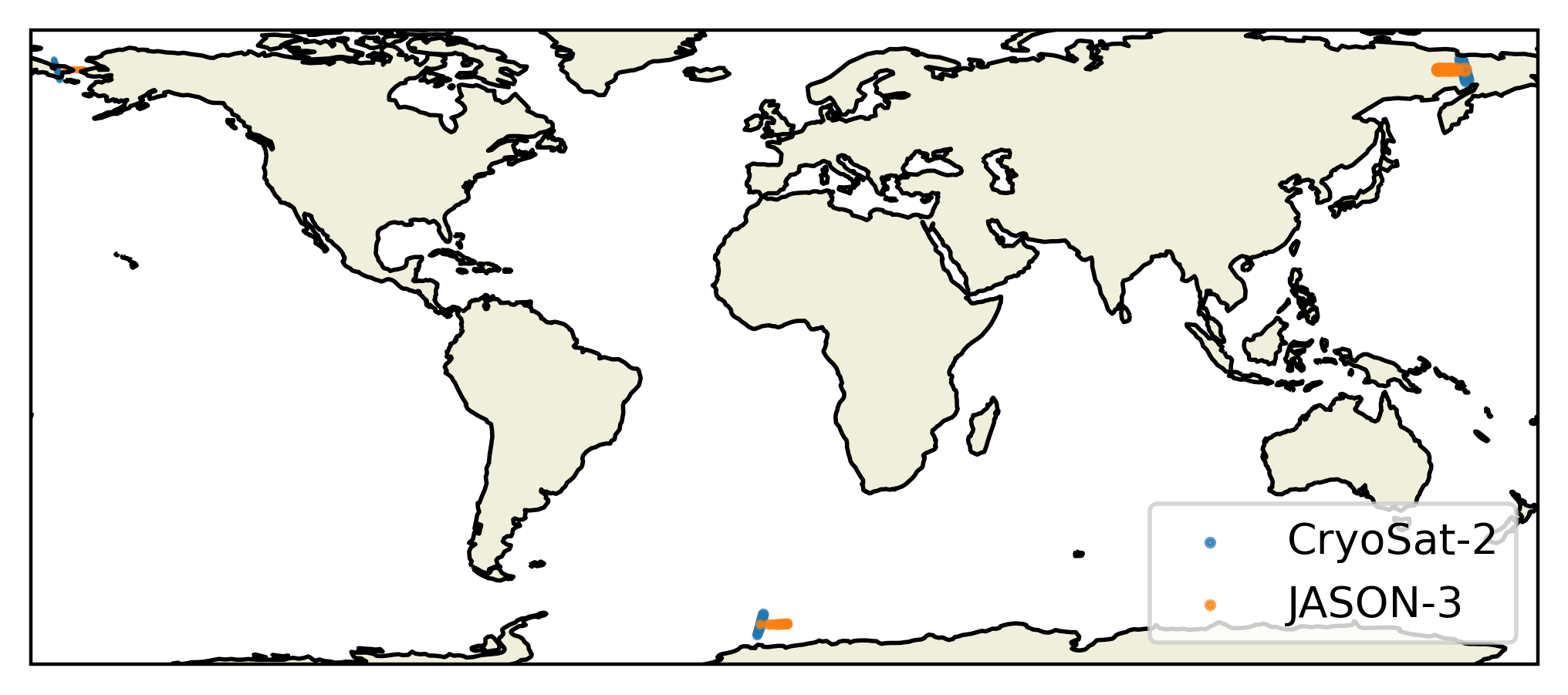
The matchups attribute is at the core of the Matchups objects.
It contains an xarray with a time coordinate (float64 in seconds since reference date) giving the time at which the first satellite in the satellites list got in the matchup.
For each satellite in the list the xarray contains the variables lat<i> and lon<i> which represent the latitude and longitude of the satellite at the time it joined the matchup.
print(matchups.matchups)
<xarray.Dataset> Size: 5kB
Dimensions:         (matchup_index: 53, satellite: 2, satellite_pair: 1)
Coordinates:
* satellite       (satellite) <U3 24B 'CS2' 'J3'
* satellite_pair  (satellite_pair) <U6 24B 'CS2_J3'
* matchup_index   (matchup_index) int64 424B 0 1 2 3 4 5 ... 47 48 49 50 51 52
Data variables:
    reference_date  datetime64[s] 8B 2000-01-01
    time_datetime   (matchup_index, satellite) datetime64[s] 848B 2012-01-01T...
    time            (matchup_index, satellite) float64 848B 3.787e+08 ... 3.7...
    lat             (matchup_index, satellite) float64 848B 63.72 66.12 ... 66.1
    lon             (matchup_index, satellite) float64 848B -173.1 ... 159.0
    distance        (matchup_index, satellite_pair) float64 424B 279.4 ... 287.3
    delay           (matchup_index, satellite_pair) timedelta64[s] 424B 00:09...
    land_mask       (matchup_index, satellite) <U1 424B 'O' 'O' 'O' ... 'O' 'O'
    matchup_type    (matchup_index) <U1 212B 'O' 'O' 'O' 'O' ... 'O' 'O' 'O' 'O'
Attributes: (12/13)
    satellite_shortname:              ['CS2', 'J3']
    satellite_name:                   ['CryoSat-2', 'JASON-3']
    start_date:                       378690300.0
    end_date:                         378735300.0
    propagation_sampling_interval:    60
    interpolation_sampling_interval:  5
    time_diff_threshold               900.0
    space_diff_threshold:             290.0
    check_before:                     1
    check_after:                      1
    has_land_ocean_mask:              1
    version:                          1.0
    creation_date:                    2026-01-06T13:20:37
Finally, a Matchups object can be exported to and loaded from netcdf4 files:
matchups.to_netcdf("./test_export/")
loaded_matchup = Matchups.from_netcdf("./test_export/2012-01-01_2012-01-01_psi60.0_isi5.0_matchups_CS2_J3_c2c290.0_tdt900.0.nc")
print(matchups == loaded_matchup)
True
If you are looking for matchups involving satellites not included “natively” in OrbitX, you can use your own TLE file to obtain matchups.
To this effect, use the custom_satellite argument as demonstrated below:
matchups_custom = Matchups.find_matchups(
    satellites=[],
    start_date=np.datetime64("2012-01-01T00:00:00"),
    end_date=np.datetime64("2012-01-01T12:00:00"),
    propagation_sampling_interval=np.array(60, dtype="timedelta64[s]"),
    interpolation_sampling_interval=np.array(5, dtype="timedelta64[s]"),
    space_diff_threshold=290,
    time_diff_threshold=np.array(900, dtype="timedelta64[s]"),
    check_before=True,
    check_after=True,
    has_land_ocean_mask=True,
    reference_date=np.datetime64("2000-01-01T00:00:00"),
    custom_satellites=[
        {
            "tle_filepath": r"..\orbitx\data\tle\TLEset_CS2.txt",
            "satellite_shortname": "CS2",
            "satellite_name": "CryoSat-2"
        },
        {
            "tle_filepath": r"..\orbitx\data\tle\TLEset_J3.txt",
            "satellite_shortname": "J3",
            "satellite_name": "Jason-3"
        }
    ]
)
print(matchups_custom == matchups)
True
Here we have used satellites included in OrbitX so we can demonstrate that the result is indeed the same.